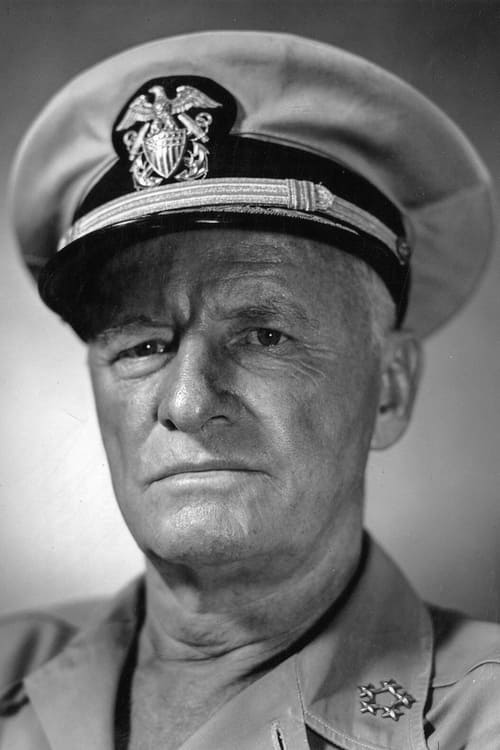
Chester W. Nimitz
I PERSONAL INFO
Chester William Nimitz (; 24 February 1885 – 20 February 1966) was a fleet admiral in the United States Navy. He played a major role in the naval history of World War II as Commander in Chief, US Pacific Fleet, and Commander in Chief, Pacific Ocean Areas, commanding Allied air, land, and sea forces during World War II. Nimitz was the leading U.S. Navy authority on submarines. Qualified in submarin...
Chester William Nimitz (; 24 February 1885 – 20 February 1966) was a fleet admiral in the United States Navy. He played a major role in the naval history of World War II as Commander in Chief, US Pacific Fleet, and Commander in Chief, Pacific Ocean Areas, commanding Allied air, land, and sea forces during World War II. Nimitz was the leading U.S. Navy authority on submarines. Qualified in submarines during his early years, Nimitz later oversaw the conversion of these vessels' propulsion from gasoline to diesel, and then later was key in acquiring approval to build the world's first nuclear-powered submarine, USS Nautilus, whose propulsion system later completely superseded diesel-powered submarines in the United States. Beginning in 1917, Nimitz was the Navy's leading developer of underway replenishment techniques, the tool which during the Pacific war would allow the American fleet to operate away from port almost indefinitely. The chief of the Navy's Bureau of Navigation from 1939 to 1942, Nimitz served as the chief of naval operations from 1945 until 1947. He was the United States' last surviving officer who served in the rank of fleet admiral. The USS Nimitz supercarrier, the lead ship of her class, is named after Nimitz. Early life and education Nimitz, a German Texan, was born the son of Anna Josephine (née Henke) and Chester Bernhard Nimitz on 24 February 1885, in Fredericksburg, Texas, where his grandfather's hotel is now the National Museum of the Pacific War. His frail, rheumatic father had died six months earlier, on 14 August 1884. In 1890, Anna married William Nimitz (1864–1943), Chester B. Nimitz's brother. He was significantly influenced by his German-born paternal grandfather, Charles Henry Nimitz, a former seaman in the German Merchant Marine, who taught Nimitz, "the sea – like life itself – is a stern taskmaster. The best way to get along with either is to learn all you can, then do your best and don't worry – especially about things over which you have no control". His grandfather had become a Texas Ranger in the Texas Mounted Volunteers in 1851 and later served as captain of the Gillespie Rifles Company in the Confederate States Army during the Civil War. Originally, Nimitz applied to West Point in hopes of becoming an Army officer, but no appointments were available. James L. Slayden, US Representative for Texas's 12th congressional district, told Nimitz that he had one appointment available for the United States Naval Academy and that he would award it to the best-qualified candidate. Nimitz felt that this was his only opportunity for further education and spent extra time studying to earn the appointment. Nimitz was appointed to the Naval Academy by Slayden in 1901, and graduated with distinction on 30 January 1905, seventh in a class of 114. Military career Early career Nimitz joined the battleship USS Ohio (BB-12) in San Francisco, and cruised on her to the Far East. In September 1906, he was transferred to the cruiser Baltimore; on 31 January 1907, after the two years at sea as a warrant officer then required by law, Nimitz was commissioned as an ensign. Remaining on Asiatic Station in 1907, he successively served on the gunboat Panay, destroyer Decatur, and cruiser Denver. The destroyer Decatur ran aground on a mud bank in the Philippines on 7 July 1908, while under the command of Ensign Nimitz. The incident was the result of a navigational error. Nimitz had failed to check the harbor's tide tables and tried Batangas' harbor when the water level was low, leaving Decatur stuck until the tide rose again the next morning, and she was pulled free by a small steamer. Following the grounding, a naval board of inquiry was convened to investigate the circumstances. The board found that Nimitz had indeed made an error in judgment, and he received a letter of reprimand. Nimitz returned to the United States on board USS Ranger when that vessel was converted to a school ship, and in January 1909, began instruction in the First Submarine Flotilla. In May of that year, he was given command of the flotilla, with additional duty in command of USS Plunger, later renamed A-1. Nimitz was promoted directly from ensign to lieutenant in January 1910. He commanded USS Snapper (later renamed C-5) when that submarine was commissioned on 2 February 1910, and on 18 November 1910, assumed command of USS Narwhal (later renamed D-1). In the latter command, Nimitz had additional duty on 10 October 1911, as Commander 3rd Submarine Division Atlantic Torpedo Fleet. In November 1911, he was ordered to the Boston Navy Yard, to assist in fitting out USS Skipjack and assumed command of that submarine, which had been renamed E-1, at her commissioning on 14 February 1912. On the monitor Tonopah (then employed as a submarine tender) on 20 March 1912, Nimitz rescued Fireman Second Class W. J. Walsh from drowning, receiving a Silver Lifesaving Medal for his action. After commanding the Atlantic Submarine Flotilla from May 1912 to March 1913, Nimitz supervised the building of diesel engines for the fleet oil tanker Maumee, under construction at the New London Ship and Engine Company, Groton, Connecticut. World War I In the summer of 1913, Nimitz (who spoke fluent German) studied engines at the Maschinenfabrik-Augsburg-Nürnberg (M.A.N.) diesel engine plants in Nuremberg, Germany, and Ghent, Belgium. Returning to the New York Navy Yard, he became executive and engineer officer of Maumee at her commissioning on 23 October 1916. After the United States declared war on Germany in April 1917, Nimitz was chief engineer of Maumee while the vessel served as a refueling ship for the first squadron of US Navy destroyers to cross the Atlantic, to take part in the war. Under his supervision, Maumee conducted the first-ever underway refuelings. On 10 August 1917, Nimitz became aide to Rear Admiral Samuel S. Robison, Commander, Submarine Force, US Atlantic Fleet (ComSubLant). On 6 February 1918, Nimitz was appointed chief of staff and was awarded a Letter of Commendation for meritorious service as COMSUBLANT's chief of staff. On 16 September, he reported to the office of the Chief of Naval Operations, and on 25 October, was given additional duty as senior member, Board of Submarine Design. Interwar Period From May 1919 to June 1920, Nimitz served as executive officer of the battleship South Carolina. He then commanded the cruiser Chicago with additional duty in command of Submarine Division 14, based at Pearl Harbor, Hawaii. Nimitz, assisted by four earnest Chief Petty Officers, supervised the construction of Submarine Base Pearl Harbor on a triangle-shaped, overgrown piece of land at the juncture of Southeast Loch and Quarry Loch, and served as the base's first commanding officer. During this tour, he also conducted an investigation into the R-14 sailing incident. Nimitz's handling of the disciplinary action in the aftermath of the investigation was considered a model of even-handed fairness, cementing his reputation as a solid and capable leader. Returning to the mainland in the summer of 1922, Nimitz studied at the Naval War College, Newport, Rhode Island.In June 1923, Nimitz became aide and assistant chief of staff to the Commander, Battle Fleet, and later to the Commander in Chief, United States Fleet. In August 1926, he went to the University of California, Berkeley, where he established one of the first Naval Reserve Officer Training Corps units and successfully advocated for the program's expansion. Nimitz lost part of his left ring finger in an accident with a diesel engine, saving the rest of it only when the machine briefly jammed against his Annapolis ring. In June 1929, Nimitz took command of Submarine Division 20. In June 1931, he assumed command of the destroyer tender Rigel and the destroyers out of commission at San Diego, California. In October 1933, Nimitz took command of the cruiser Augusta and deployed to the Far East, where in December, Augusta became the flagship of the Asiatic Fleet. While in command of the Augusta, his legal aide was Chesty Puller. In April 1935, Nimitz returned home for three years as assistant chief of the Bureau of Navigation, before becoming commander, Cruiser Division 2, Battle Force. In September 1938, Nimitz took command of Battleship Division 1, Battle Force. During this time, he conducted experiments in the underway refueling of large ships which would prove a key element in the Navy's success in the war to come. "Tests were planned for the spring of 1939 [June 1939] using elements of the fleet left on the West Coast while the rest of the fleet was in the Caribbean participating in Fleet Problem XX. Nimitz was scheduled to remain on the West Coast aboard his flagship the Arizona. The aircraft carrier Saratoga, the heavy cruisers Chester and Vincennes, and the light cruiser Trenton would also be left behind. These ships, with their escorts and at least one oiler, would constitute Task Force 7. Nimitz, as senior officer present, would be in command." On 15 June 1939, Nimitz was appointed chief of the Bureau of Navigation. From 1940 to 1941, he served as president of the Army Navy Country Club, in Arlington, Virginia. World War II Ten days after the attack on Pearl Harbor on 7 December 1941, Rear Admiral Nimitz was selected by President Franklin D. Roosevelt to be the commander-in-chief of the United States Pacific Fleet (CINCPACFLT). Nimitz immediately departed Washington for Hawaii and took command in a ceremony on the top deck of the submarine Grayling. He was promoted to the rank of admiral, effective 31 December 1941, upon assuming command. The change of command ceremony would normally have taken place aboard a battleship, but every battleship in Pearl Harbor had been either sunk or damaged during the attack. Assuming command at the most critical period of the war in the Pacific, Admiral Nimitz organized his forces to halt the Japanese advance, despite the shortage of ships, planes, and supplies. Nimitz had a significant advantage in that the United States had cracked the Japanese diplomatic code and had made progress on the naval code JN-25. The Japanese had kept radio silence before the attack on Pearl Harbor, although events were then moving so rapidly that they had to rely on coded radio messages they did not realize were being read in Hawaii. On 24 March 1942, the newly formed US-British Combined Chiefs of Staff issued a directive designating the Pacific theater an area of American strategic responsibility. Six days later, the US Joint Chiefs of Staff (JCS) divided the theater into three areas: the Pacific Ocean Areas, the Southwest Pacific Area (commanded by General Douglas MacArthur), and the Southeast Pacific Area. The JCS designated Nimitz as "Commander in Chief, Pacific Ocean Areas", with operational control over all Allied units (air, land, and sea) in that area. Nimitz, in Hawaii, and his superior Admiral Ernest King, the Chief of Naval Operations, in Washington, rejected the plan of General Douglas MacArthur to advance on Japan through New Guinea and the Philippines and Formosa. Instead, they proposed an island-hopping plan that would allow them to bypass most of the Japanese strength in the Central Pacific until they reached Okinawa. President Roosevelt compromised, giving both MacArthur and Nimitz their own theaters. The two Pacific theaters were favored, to the dismay of generals George Marshall and Dwight Eisenhower, who favored a Germany-first strategy. King and Nimitz provided MacArthur with some naval forces but kept most of the carriers. However, when the time came to plan an invasion of Japan, MacArthur was given overall command. Nimitz faced superior Japanese forces at the crucial defensive actions of the Battle of the Coral Sea and the Battle of Midway. The Battle of the Coral Sea, while a loss in terms of total damage suffered, has been described as resulting in the strategic success of turning back an apparent J
Sponsored